
How EPR Targets Are Calculated Under the E-Waste (Management) Rules, 2022(As Amended): A Complete Technical Guide
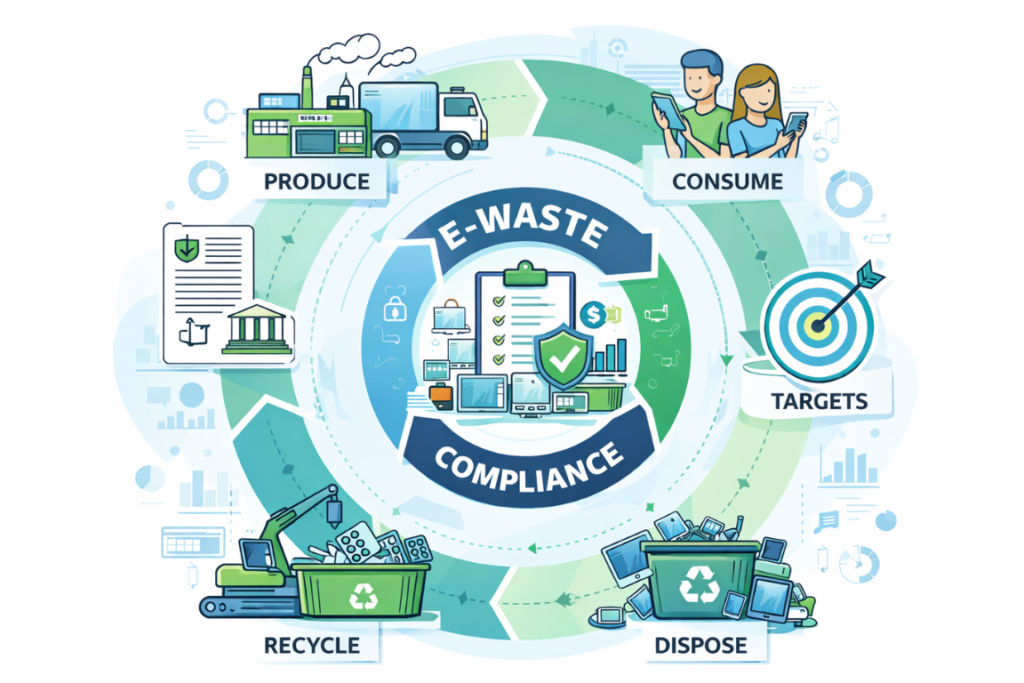
India’s E-Waste (Management) Rules, 2022 have brought a new level of
accountability to producers of electronic and electrical equipment. For leaders and
compliance teams, understanding how Extended Producer Responsibility (EPR)
targets are calculated is essential—not just for compliance, but for strategic planning
and risk mitigation.
Whether you are a Producer, Consultant, Recycler, or Aggregator, this guide
simplifies the most confusing part of the E-Waste Rules — how EPR targets are
calculated and verified.
1. Identifying the Obligated Product and Its Useful Life
The entire target calculation process begins with understanding the useful life of the
obligated EEE product.
The Central Pollution Control Board (CPCB) has published:
- List of Obligated EEE Items, and
- Average Useful Life of Each Item,
on its Portal for EPR under E-Waste (Management) Rules, 2022.
This list includes certain product-level break-ups not explicitly listed in the Rules but
notified by CPCB for operational clarity.
Why is Useful Life important?
Because it determines how many years of historical sales must be considered for:
- Registration under the Rules
- EPR Target Computation
For example:
If a laptop category has a useful life of 5 years, then the producer must provide at
least 5 years of historical Pan-India sales data (in MT).
2. Sales Data Reporting Based on Useful Life
Once useful life is identified, the producer must compute the total quantity of EEE
sold in India for the corresponding past years.
Rules for Reporting Sales Weight:
- ✔ Report net weight of EEE only
- ✘ Exclude packaging weight
- ✘ Exclude battery weight (if covered under Battery Waste Management Rules, 2022)
Example:
If you apply for registration in FY 2023–24, and your product has a useful life of 5
years:
You must report sales from: FY 2018–19 → FY 2022–23
This aligns with CPCB’s SOP for Grant of Registration to Producers.
Important Validation Check:
Before submitting your EPR registration, verify that you have: Sales data (in MT) for
all years equal to the product’s average life.
This ensures your EPR targets are computed correctly and avoids registration
rejection.
3. Calculating the EPR Target Weight
EPR targets are calculated differently depending on how long the producer has been
operating.
There are two possible scenarios:
Scenario A: Number of years of sales operation ≥ Useful Life
Applicable Schedule: Schedule III
If the producer has been selling the product for more years than its useful life, EPR
targets are calculated using the formula:
Target Quantity = % Target × Sales in FY (Y – X) Where:
- Y = Target Year
- X = Useful Life
| Target Year | Target % | Sales year to be considered if average life is equal to: | ||
|---|---|---|---|---|
| 5 Years | 8 Years | 10 Years | ||
| 2023-24 | 60% | 2018-19 | 2015-16 | 2013-14 |
| 2024-25 | 60% | 2019-20 | 2016-17 | 2014-15 |
| 2025-26 | 70% | 2020-21 | 2017-18 | 2015-16 |
| 2026-27 | 70% | 2021-22 | 2018-19 | 2016-17 |
| 2027-28 | 80% | 2022-23 | 2019-20 | 2017-18 |
| 2028-29 | 80% | 2023-24 | 2020-21 | 2018-19 |
Targets as per Schedule III
Scenario B: Number of years of sales operation < Useful Life
Applicable Schedule: Schedule IV
This applies to new entrants and producers with recent market presence. (Not to be
confused with Date of Incorporation of the Entity, the criteria here is “Number of
years of sales operation”)
| Target | Target % | Sales Year |
|---|---|---|
| 2023-24 | 15% | 2021-22 |
| 2024-25 | 20% | 2022-23 |
| 2025-26 onwards | 20% | FY “two years back” |
Targets as per Schedule IV
Once the number of years of sales equals the useful life, the producer shifts
automatically to Schedule III.
This has to be seen at a EEE Code level and not the Company Level.
4. Converting Target Weights into Metal-Wise Targets
The Central Pollution Control Board has published a metal composition
framework, listing average recoverable percentages of key metals for each EEE
category.
Why? An Electrical or Electronic Equipment might have various materials i.e.
Plastics, Silver, Iron, Copper etc
But EPR certificates are issued only for recovery of key metals, not for total
product weight.
Three Metal Groups Defined by CPCB:
- 1. Precious Metals- Gold (Au)
- 2. Non-Ferrous Metals- Copper (Cu), Aluminium (Al)
- 3. Ferrous Metals- Iron (Fe)
Illustrative Example: Laptop (ITEW3)
Assume a producer’s total EPR target = 1,000 kg of laptops.
CPCB’s Average Metal Composition for Laptops:
- 1. Gold (Au)- 0.0004%
- 2. Copper (Cu)- 0.19%
- 3. Iron (Fe)- 5%
- 4. Aluminium (Al)- 11%
Hence, out of the total weight 1,000kg of Laptop, the EPR certificates are to be procured only for 161.904 Kgs. The break down is below-
- 1. Gold (Au)- 4grms
- 2. Copper (Cu)- 1.9kg
- 3. Iron (Fe)- 50kg
- 4. Aluminium (Al)- 110kg
This breakdown determines how many EPR certificates must be purchased or
generated. The EPR Certificates are available in various denominations viz.
0.000001 Kg, 0.00001 Kg, 0.0001 Kg, 0.001 Kg, 0.01 Kg, 0.1 Kg, 0.5 Kg, 1 Kg, 10
Kg, 50 Kg, 100 Kg, 500 Kg, 1000 Kg.
Due to lower capacity for recovering gold from the E-Waste, there are some
relaxations provided but it is a complex calculation in itself. Hence, let’s keep that for
some other day.
| Sales Financial Year | Qty Sold (In Kgs) | Target Year | Target % | Target Qty (In MTs) | Percentage of recoverable Key Metals | |||
|---|---|---|---|---|---|---|---|---|
| Gold | Copper | Iron | Aluminium | |||||
| (Au) (In Grms) 0.00% |
(Cu) (In Kgs) 0.19% |
(Fe) (In Kgs) 5% |
(Al) (In Kgs) 11% |
|||||
| 2017-18 | 1,000 | - | 0% | - | - | - | - | - |
| 2018-19 | 1,100 | 2023-24 | 60% | 660 | 2.6 | 1.3 | 33 | 72.6 |
| 2019-20 | 1,210 | 2024-25 | 60% | 726 | 2.9 | 1.4 | 36.3 | 79.9 |
| 2020-21 | 1,331 | 2025-26 | 70% | 932 | 3.7 | 1.8 | 46.6 | 102.5 |
| 2021-22 | 1,465 | 2026-27 | 70% | 1,026 | 4.1 | 1.9 | 51.3 | 112.9 |
| 2022-23 | 1,612 | 2027-28 | 80% | 1,290 | 5.2 | 2.5 | 64.5 | 141.9 |
| 2023-24 | 1,774 | 2028-29 | 80% | 1,420 | 5.7 | 2.7 | 71 | 156.2 |
| 2024-25 | 1,952 | 2029-30 | 80% | 1,562 | 6.2 | 3 | 78.1 | 171.8 |
Year Wise Target
Final Thoughts
Understanding EPR target calculations is crucial for:
- Ensuring regulatory compliance
- Budgeting and forecasting EPR credit requirements
- Avoiding compliance gaps and penalties
- Preparing for CPCB audits and verifications
The E-Waste (Management) Rules, 2022 rely heavily on accurate historical sales
and proper interpretation of Schedules III and IV. Producers who maintain clean
records and adopt a structured compliance approach can easily align with CPCB’s
EPR framework.
As per CPCB’s Guidelines for Authorization of EPR ETP (EPR Electronic Trading
Platform) Operators, the tradable EPR certificate categories are restricted to end-
product metals (except in refurbishment cases). This means producers can only
purchase credits for metals—not EEE codes.
Additionally, due to limited national capacity for gold recovery, certain relaxations
exist, but those involve complex calculations and deserve a separate deep dive.